
Audiototext

Practical transcription examples

Explore transcribe audio to text converter examples for everyday work

These transcribe audio to text converter examples show how spoken material can become a draft transcript, then a document someone can actually use. Compare the starting audio, the first pass, and the checks that make the result dependable.

Free to start · no signup
Audiototext landing-page illustration

the audience's existing pipeline

Most recordings already have a destination: meeting notes, research findings, an article draft, or a searchable archive. The missing piece is often a written record that preserves what was said.

where we slot in

An audio to text converter can supply the first written pass. A person still needs to check names, speakers, and ambiguous passages against the recording.

  1. 1

    Start with a usable recording

    Choose the interview, meeting, or voice note you need in writing. Listen briefly for clipped beginnings, competing speakers, and background noise; those conditions affect how much review the draft will need.

  2. 2

    Create a transcript draft

    Use the linked service to explore transcription, then keep the audio available beside the text. Treat the first pass as a working record, not proof that every word, speaker, or technical term is correct.

  3. 3

    Review for the intended reader

    Replay uncertain phrases, correct names and numbers, and separate speakers where you can verify who spoke. Only then turn the transcript into notes, quotations, action items, or a document for colleagues.

before/after

The useful comparison is not audio versus perfect prose. It is an unstructured spoken record versus a checked transcript that retains the details a reader needs.

Before: recording or rough notes
After: reviewed transcript

Interview answer

Before: recording or rough notes

A spoken answer runs across several pauses; the interviewer interrupts with a follow-up.

After: reviewed transcript

The answer and follow-up appear on separate lines, with wording checked against the audio.

Meeting decision

Before: recording or rough notes

A decision is buried between discussion, objections, and a change of topic.

After: reviewed transcript

The decision can be located in the transcript; a separate summary can state it without replacing the source.

Speaker identity

Before: recording or rough notes

Two similar voices make a quick exchange hard to attribute.

After: reviewed transcript

Verified speakers are labelled; uncertain attribution stays marked for review.

Names and terms

Before: recording or rough notes

A project name or unfamiliar term is easy to mishear.

After: reviewed transcript

The spelling is checked against the recording or an authoritative source.

Numbers

Before: recording or rough notes

A date, amount, or measurement is heard once in passing.

After: reviewed transcript

The number is replayed and corrected before anyone cites it.

Quotation

Before: recording or rough notes

A listener remembers the gist but not the exact wording.

After: reviewed transcript

A proposed quotation is matched to the recording, with surrounding context retained.

deliverable spec

A good deliverable depends on its use. These scenarios show which details to retain in the transcript and which belong in a separate summary.

Research interviewer

A recorded conversation contains follow-up questions, hesitations, and answers that may later be quoted. Keep the question-and-answer order intact and flag words that cannot be verified.

A reviewable source transcript, with any thematic summary kept separate from what the participant actually said.

free audio to text converter examples

Meeting organiser

Several people discuss a deadline before settling on an owner. Verify names and dates in the transcript before drafting an action list.

A written record people can consult when they need to distinguish a suggestion from an agreed decision.

how to use audio to text converter online

Podcast editor

An episode recording needs a text reference for editing and quote selection. Check speaker changes, proper nouns, and any passage that sounds unclear.

A transcript draft that supports editing without presenting unchecked text as a final quotation.

mp3 audio to text converter online free

Field-note writer

A short voice memo captures observations faster than they can be typed. Preserve the observation first, then add interpretations in a separate note.

Searchable source wording that can be revisited without confusing later analysis with the original recording.

voice to text converter online free
Illustrative transcription workflow image Source recording
Illustrative audio-to-text examples image Reviewed written record
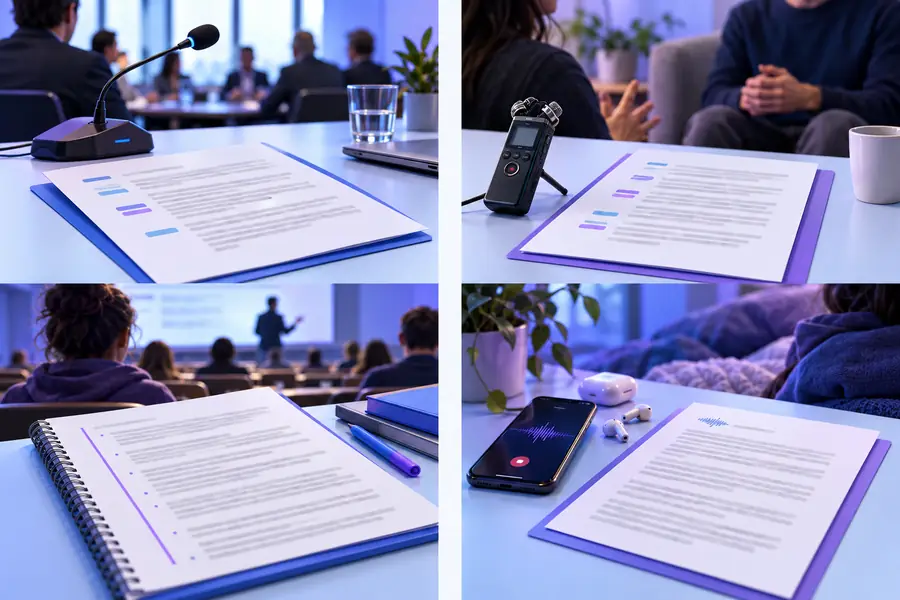
The images illustrate a workflow, not a verified transcription of pictured audio. In a real before-and-after review, check the written words against the original recording.

Turn a recording into a working transcript

Use these transcribe audio to text converter examples as a checklist for your own recording. Start with a draft, keep the source audio close, and review consequential details before sharing or quoting the text.

Transcribe your audio
  • Check names, dates, and numbers
  • Mark uncertain words instead of guessing
  • Keep summaries separate from source wording

scenario FAQ

A recorded interview is a clear example: the recording becomes a question-and-answer draft that can be checked line by line. The deliverable should preserve the speaker's wording, while uncertain phrases remain marked until someone replays them.

No. A transcript records the discussion in spoken order, while minutes select decisions, responsibilities, and next steps. Review the transcript first so the shorter minutes do not turn a tentative suggestion into an agreed action.

Replay the passage with its surrounding context and check any relevant names or terminology. If the word still cannot be established, mark it as uncertain rather than inserting a plausible guess.

Check the quotation against the recording before publishing or sharing it as someone's exact words. Pay particular attention to negations, numbers, speaker identity, and where the quotation begins and ends.

Confirm that the intended recipients may access the recording and its contents. Then review sensitive details, speaker labels, proper nouns, and any passages where an error could change the meaning.

Transcribe audio
Transcribe audio